Human Anatomy & Physiology Laboratory Manual 13th Edition PDF: Article Plan
This comprehensive guide details the 13th edition’s content, covering essential laboratory exercises and system-specific modules for students and educators alike.
It explores the cat and fetal pig versions, highlighting key features, dissection procedures, and physiological data analysis techniques for effective learning.
Resources for PDF downloads and ethical considerations are also discussed, alongside insights into future updates and the contributions of Marieb & Smith.
The Human Anatomy & Physiology Laboratory Manual, 13th Edition, stands as a cornerstone resource for students embarking on the intricate journey of understanding the human body. This manual, often available in both cat and fetal pig versions, is meticulously designed to complement any introductory anatomy and physiology course. It’s more than just a collection of exercises; it’s a practical guide built to reinforce theoretical knowledge through hands-on exploration.
Developed by renowned authors Elaine N. Marieb and Lori A. Smith, this edition continues a legacy of clarity and comprehensive coverage. The manual’s primary aim is to provide a structured laboratory experience, enabling students to develop essential skills in anatomical identification, physiological measurement, and data analysis.
Whether you’re seeking a downloadable PDF for convenient access or a physical copy for traditional learning, the 13th edition offers a wealth of resources. It’s a vital tool for both students and educators, fostering a deeper appreciation for the complexities and wonders of human biology. The manual’s organization and detailed instructions ensure a smooth and effective learning process.
Overview of Human Anatomy and Physiology
Human anatomy and physiology explore the body’s structure and function, a foundational science for healthcare professionals. Anatomy details the physical components – organs, tissues, and cells – while physiology investigates how these components work together to maintain life. The Human Anatomy & Physiology Laboratory Manual, 13th Edition, directly supports this study.
Understanding these interconnected systems is crucial, from the skeletal framework providing support to the nervous system coordinating responses. This manual bridges the gap between theory and practice, allowing students to visualize and manipulate anatomical structures. The 13th edition’s exercises cover everything from microscopic histology to macroscopic dissections.
The manual’s content aligns with core A&P principles, offering a progressive learning experience. Whether utilizing the cat or fetal pig version, students gain practical skills in observation, dissection, and data interpretation. Accessing the PDF version provides convenient, on-demand learning, reinforcing concepts and preparing students for future studies and careers.
The Importance of Laboratory Studies
Laboratory studies are paramount in mastering human anatomy and physiology, transforming abstract concepts into tangible realities. The Human Anatomy & Physiology Laboratory Manual, 13th Edition, emphasizes this experiential learning. Simply reading about the body isn’t enough; hands-on investigation solidifies understanding.
Dissection, microscopy, and physiological experiments allow students to observe structures firsthand, fostering a deeper appreciation for their complexity. The 13th edition’s exercises are designed to develop critical thinking and problem-solving skills, essential for future healthcare professionals. The PDF format enhances accessibility, enabling flexible study schedules.
Practical application reinforces theoretical knowledge, bridging the gap between textbook descriptions and real-world anatomy. Whether using the cat or fetal pig version, students gain invaluable skills in data collection and analysis. This manual isn’t just a guide; it’s a gateway to a comprehensive understanding of the human body and its intricate functions.
About the 13th Edition
The 13th Edition of the Human Anatomy & Physiology Laboratory Manual represents a significant update to a long-standing, trusted resource. This iteration builds upon previous editions, offering enhanced clarity and improved pedagogical features. Expect detailed, well-illustrated instructions, often utilizing labeled diagrams and photographs to guide students through each exercise.
The manual continues to provide comprehensive coverage of essential laboratory techniques, including microscopy, dissection, and physiological data collection. The PDF version ensures convenient access for students and educators alike, facilitating both in-lab and remote learning experiences.
Reviewers have contributed to refining the content, ensuring accuracy and relevance. This edition likely incorporates feedback from instructors and students, resulting in a more user-friendly and effective learning tool. It’s designed to make complex concepts accessible, fostering a deeper understanding of human anatomy and physiology.

Key Authors: Marieb & Smith
Elaine N. Marieb and Lori A. Smith are the driving forces behind the enduring success of the Human Anatomy & Physiology Laboratory Manual. Marieb, a renowned author in the field, brings decades of experience in teaching anatomy and physiology to her work. Her dedication to clarity and student understanding is evident throughout the manual.
Lori A. Smith collaborates closely with Marieb, contributing her expertise to refine and update the content. Together, they have created a resource that is both comprehensive and accessible. Their combined efforts ensure the manual remains a leading choice for anatomy and physiology courses.
The 13th Edition reflects their commitment to providing students with the tools they need to succeed. They acknowledge the importance of feedback and welcome suggestions for future editions, demonstrating a continuous pursuit of improvement. Their authorship guarantees a high-quality PDF resource.
Target Audience: Students and Educators
The Human Anatomy & Physiology Laboratory Manual, 13th Edition, is meticulously designed for both students and educators within the allied health and biology disciplines. Students enrolled in introductory anatomy and physiology courses will find it an invaluable companion, offering clear guidance through complex laboratory exercises.
Educators benefit from the manual’s structured format and detailed instructions, simplifying lab preparation and ensuring consistent learning outcomes. The manual supports a variety of teaching approaches, accommodating diverse classroom settings and learning styles.
Whether utilizing the cat or fetal pig version, the PDF format provides convenient access to essential materials. It’s ideal for those seeking a comprehensive resource to enhance understanding of human body structure and function. This edition caters to anyone needing a robust, well-illustrated guide for anatomical study.
Content Organization & Structure
The Human Anatomy & Physiology Laboratory Manual, 13th Edition, boasts a logical and progressive structure, designed to build understanding incrementally. It begins with foundational exercises – microscopy and basic measurements – before delving into histological studies of epithelial and connective tissues.
The manual then transitions into system-specific modules, covering skeletal, muscular, nervous, and endocrine systems in detail. Each module features carefully crafted laboratory activities, complemented by clear illustrations and step-by-step instructions.
The PDF version maintains this organization, offering easy navigation and accessibility. Exercises are presented in a manner that promotes hands-on learning and critical thinking. The content is broken down into manageable sections, facilitating effortless comprehension of complex anatomical concepts. This structure ensures a cohesive and effective learning experience for students utilizing the 13th edition.
The Cat Version vs. Fetal Pig Version
The Human Anatomy & Physiology Laboratory Manual, 13th Edition, is available in two primary dissection versions: cat and fetal pig. Both versions aim to provide a comprehensive understanding of mammalian anatomy, but differ in their anatomical similarities to humans.
The cat version offers closer resemblance to human musculature and skeletal structure, making it ideal for detailed comparative studies. Conversely, the fetal pig version is often favored for its lower cost and ease of dissection, while still providing valuable anatomical insights.
The 13th Edition PDF maintains consistent exercise content across both versions, adapting only the specific anatomical references to match the chosen specimen. Students can expect similar learning objectives and assessment criteria regardless of the dissection animal. Choosing between the two depends on institutional preference, budgetary constraints, and specific pedagogical goals.
Key Features of the 13th Edition
The 13th Edition of the Human Anatomy & Physiology Laboratory Manual boasts several key enhancements designed to optimize the learning experience. These include meticulously detailed, well-illustrated instructions, often utilizing clearly labeled diagrams and photographs to guide students through each exercise.
A significant feature is the integration of practical applications, connecting anatomical concepts to real-world physiological processes. The manual emphasizes hands-on learning, fostering a deeper understanding of complex topics through active engagement.
Furthermore, the 13th Edition incorporates updated content reflecting the latest advancements in the field, ensuring students receive current and relevant information. Reviewers have contributed to refining the manual, and the PDF format offers convenient accessibility. It breaks down complex concepts into simple, understandable steps, making learning effortless.
Detailed Laboratory Exercises

The Human Anatomy & Physiology Laboratory Manual, 13th Edition, provides a robust collection of detailed laboratory exercises, starting with foundational techniques like Exercise 1: The Microscope & Its Use, crucial for histological studies. Students progress through essential body measurements and vital signs assessments in Exercise 2.
Histological investigations are thoroughly covered in Exercises 3 and 4, focusing on epithelial and connective tissues respectively. These exercises build a strong base for understanding tissue structure and function. The manual then transitions into system-specific modules, offering in-depth explorations of the skeletal, muscular, nervous, and endocrine systems.
Each exercise is designed with clarity and precision, guiding students through procedures and data analysis. The PDF version ensures easy access to these comprehensive exercises, supporting effective learning and practical skill development. These exercises are designed to reinforce theoretical knowledge with hands-on experience.
Exercise 1: The Microscope & Its Use
Exercise 1 in the Human Anatomy & Physiology Laboratory Manual, 13th Edition, centers on mastering the microscope – a fundamental tool in anatomical studies. This exercise meticulously guides students through the identification of microscope parts, proper usage techniques, and essential maintenance procedures.
Students learn about magnification, resolution, and the principles of light microscopy. The manual provides detailed instructions on preparing wet mounts and stained slides, crucial skills for observing various tissue types. Emphasis is placed on correct focusing techniques and the use of different objective lenses.
The PDF version of this exercise includes clear diagrams and illustrations, enhancing understanding and facilitating accurate observation. It’s a foundational step, preparing students for subsequent histological investigations. This exercise builds a critical skillset for visualizing microscopic structures, essential for comprehending anatomy and physiology.
Exercise 2: Body Measurements & Vital Signs
Exercise 2 within the Human Anatomy & Physiology Laboratory Manual, 13th Edition, focuses on obtaining and interpreting fundamental body measurements and vital signs. This practical exercise equips students with essential skills for assessing overall health and physiological function.
The manual provides step-by-step instructions for accurately measuring height, weight, body mass index (BMI), pulse rate, respiratory rate, and blood pressure. Students learn the correct techniques for using measuring tools and recording data systematically. Emphasis is placed on understanding the physiological significance of each vital sign.
The 13th edition’s PDF version offers detailed illustrations and tables for reference, aiding in accurate data collection and analysis. Students practice interpreting results within normal ranges and identifying potential deviations. This exercise is crucial for developing clinical assessment skills, forming a basis for future studies in healthcare professions.
Exercise 3: Histology – Epithelial Tissue
Exercise 3 in the Human Anatomy & Physiology Laboratory Manual, 13th Edition, delves into the microscopic world of epithelial tissues. This laboratory exercise provides a foundational understanding of these crucial tissues, which cover body surfaces and line internal organs;
The 13th edition’s PDF guide presents detailed microscopic images of various epithelial tissue types – squamous, cuboidal, and columnar – alongside transitional epithelium. Students learn to identify key characteristics, including cell shape, arrangement, and specialized features like cilia or microvilli.
The manual guides students through the process of preparing and observing slides, emphasizing proper staining techniques for optimal visualization. Students analyze tissue samples to differentiate between the various epithelial subtypes and correlate their structure with specific functions. This exercise builds essential skills in histological analysis, vital for understanding organ structure and function.
Exercise 4: Histology – Connective Tissue
Exercise 4 within the Human Anatomy & Physiology Laboratory Manual, 13th Edition, focuses on the diverse world of connective tissues. This lab exercise builds upon histological principles, introducing students to tissues that support, connect, and separate different body parts.
The 13th edition’s PDF resource offers high-quality micrographs of connective tissue proper – including loose and dense varieties – as well as specialized connective tissues like cartilage, bone, and blood. Students learn to distinguish these tissues based on cellularity, matrix composition, and fiber types (collagen, elastic, reticular).
The manual guides students in identifying chondrocytes in cartilage, osteocytes in bone, and the various blood cells. Emphasis is placed on understanding how the structure of each connective tissue relates to its specific function, such as providing support, protection, or transportation. This exercise reinforces microscopic identification skills and deepens understanding of tissue organization.
System-Specific Laboratory Modules
The Human Anatomy & Physiology Laboratory Manual, 13th Edition PDF, organizes learning through dedicated system-specific modules. These modules provide a focused, in-depth exploration of each body system, building upon foundational knowledge established in earlier exercises.
Modules cover the Skeletal, Muscular, Nervous, and Endocrine systems, among others, each featuring a series of carefully designed laboratory activities. These activities integrate dissection (depending on the version – cat or fetal pig), microscopic examination of tissues, and physiological experiments.
The 13th edition’s modules emphasize practical application, challenging students to analyze anatomical structures, interpret physiological data, and relate form to function. Detailed instructions, clear illustrations, and review questions facilitate effective learning. The PDF format allows for convenient access to these resources, enhancing the laboratory experience for both students and educators.
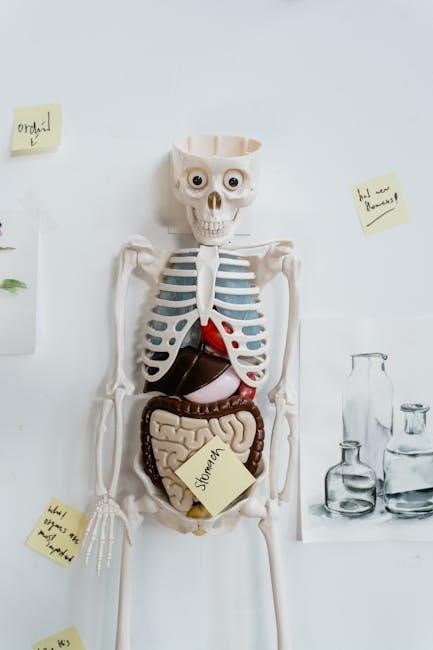
Module 1: Skeletal System
The first system-specific module within the Human Anatomy & Physiology Laboratory Manual, 13th Edition PDF, focuses on the Skeletal System. This module provides a comprehensive exploration of bone structure, classification, and function, utilizing both macroscopic and microscopic approaches.
Laboratory exercises typically involve identifying bones and their features, analyzing skeletal articulations, and examining bone tissue under the microscope. Dissection, depending on the chosen version (cat or fetal pig), allows for direct observation of skeletal elements and their relationships.
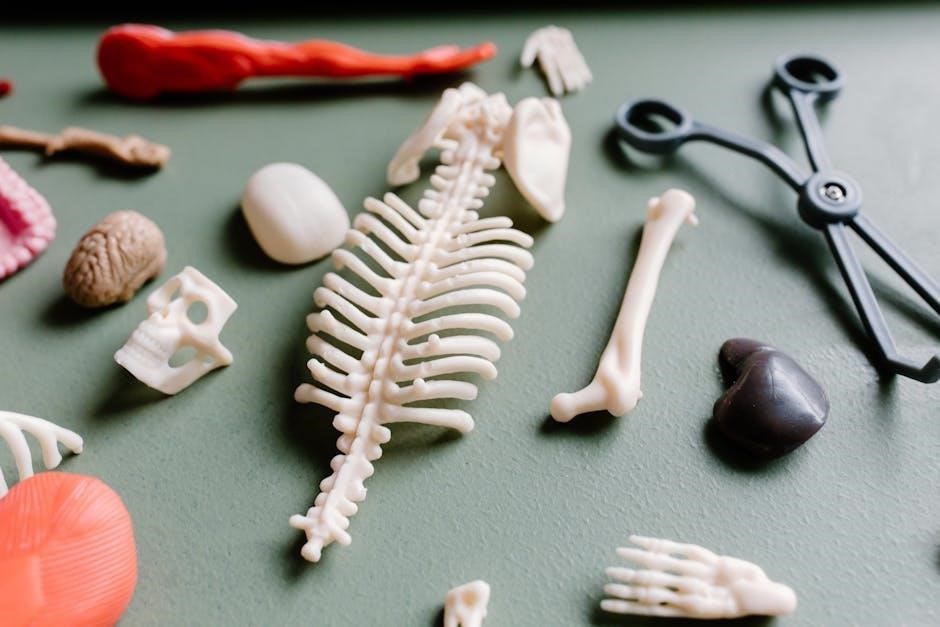
Students will learn to differentiate between various bone types – long, short, flat, and irregular – and classify joints based on their structural and functional characteristics. The 13th edition’s module emphasizes the skeletal system’s role in support, protection, movement, and mineral storage. The PDF format provides detailed illustrations and review questions to reinforce learning and prepare students for further study.
Module 2: Muscular System
Module 2 of the Human Anatomy & Physiology Laboratory Manual, 13th Edition PDF, delves into the intricacies of the Muscular System. This section emphasizes the structure, function, and classification of the three muscle tissue types: skeletal, smooth, and cardiac. The manual utilizes hands-on laboratory exercises to solidify understanding.
Students will dissect and identify major skeletal muscles, learning their origins, insertions, actions, and innervation. Microscopic examination of muscle tissue allows for differentiation between muscle fiber types and observation of contractile units. The 13th edition’s PDF provides detailed diagrams illustrating muscle anatomy and physiology.
Exercises often include measuring muscle contraction strength and analyzing the effects of exercise on muscle fatigue. The module highlights the muscular system’s crucial role in movement, posture, heat generation, and various physiological processes. The downloadable PDF format ensures accessibility and facilitates effective self-study, preparing students for advanced concepts.
Module 3: Nervous System
Module 3 within the Human Anatomy & Physiology Laboratory Manual, 13th Edition PDF, comprehensively explores the Nervous System. This section focuses on the structural and functional organization of the brain, spinal cord, and peripheral nerves. The manual employs practical laboratory exercises to enhance comprehension of neural pathways and signal transmission.
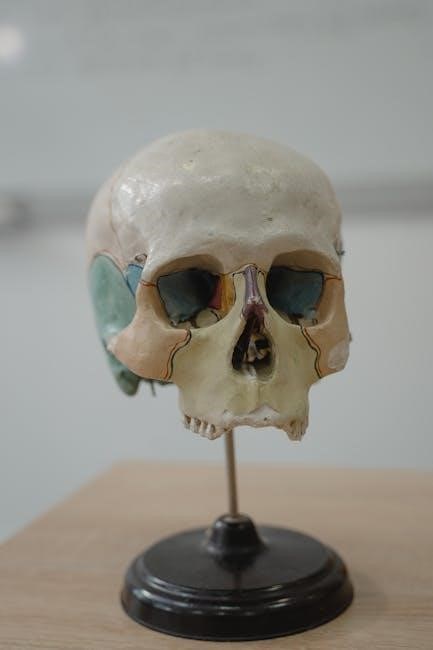
Students dissect sheep brains to identify key structures, including lobes, fissures, and functional areas. Microscopic observation of nervous tissue reveals the cellular components – neurons and glial cells – and their roles in information processing. The 13th edition’s PDF features detailed illustrations of neuroanatomy and synaptic connections.
Exercises often involve testing reflexes, mapping sensory receptors, and analyzing nerve impulse conduction. The module emphasizes the nervous system’s role in coordinating bodily functions, enabling sensory perception, and facilitating higher-level cognitive processes. Accessing the PDF version allows for convenient review and reinforces learning, preparing students for advanced neurological studies.
Module 4: Endocrine System
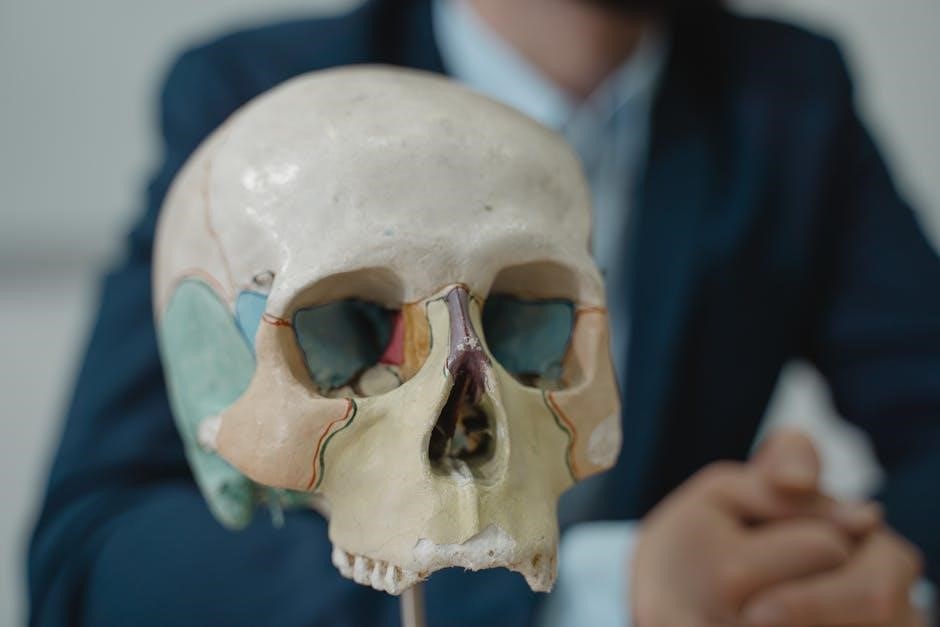
Module 4 of the Human Anatomy & Physiology Laboratory Manual, 13th Edition PDF, delves into the intricacies of the Endocrine System. This section emphasizes the hormonal regulation of bodily functions, exploring the major endocrine glands and their secreted hormones. The manual utilizes practical exercises to illustrate the impact of hormones on target tissues.
Laboratory activities often involve examining endocrine gland histology, identifying key cellular structures responsible for hormone production. Students analyze the effects of hormones on physiological parameters, such as blood glucose levels and metabolic rates. The 13th edition’s PDF provides detailed diagrams of hormone pathways and feedback mechanisms.
Exercises may include simulating endocrine disorders and predicting their consequences. The module highlights the endocrine system’s role in maintaining homeostasis, regulating growth and development, and coordinating reproductive processes. The downloadable PDF format facilitates easy access to information, supporting effective learning and preparation for further studies in endocrinology.
Advanced Laboratory Techniques
The Human Anatomy & Physiology Laboratory Manual, 13th Edition PDF, incorporates advanced techniques to enhance student understanding beyond traditional methods. This module introduces sophisticated tools and procedures used in modern physiological research and clinical diagnostics. The downloadable PDF provides step-by-step guidance for performing these techniques safely and accurately.
Students may engage in activities like spectrophotometry, used to quantify hormone levels or enzyme activity. Techniques for analyzing physiological data using software applications are also included, fostering data interpretation skills. The manual emphasizes the importance of quality control and error analysis in experimental design.
The 13th edition’s PDF often features virtual laboratory simulations, allowing students to practice complex procedures in a risk-free environment. These advanced techniques prepare students for upper-level coursework and potential careers in healthcare and research, bridging the gap between theoretical knowledge and practical application.
Dissection Procedures & Safety
The Human Anatomy & Physiology Laboratory Manual, 13th Edition PDF, dedicates significant attention to dissection procedures and, crucially, safety protocols. Whether utilizing cat or fetal pig specimens, the manual provides detailed, illustrated guides for each dissection, ensuring students can accurately identify anatomical structures. The downloadable PDF emphasizes a respectful and ethical approach to handling biological specimens.
Safety is paramount; the manual outlines comprehensive guidelines for handling dissection tools, preserving specimens, and disposing of biological waste. Students are instructed on proper personal protective equipment (PPE) usage, including gloves, goggles, and lab coats, to minimize exposure to potential hazards.
The 13th edition’s PDF often includes pre-lab quizzes to assess student understanding of dissection procedures and safety regulations. It stresses the importance of following instructions carefully and seeking guidance from instructors when needed, fostering a safe and productive learning environment for all participants.
Physiological Data Collection & Analysis
The Human Anatomy & Physiology Laboratory Manual, 13th Edition PDF, places strong emphasis on practical application through physiological data collection and analysis. Exercises guide students in measuring vital signs – like heart rate, blood pressure, and respiratory rate – and recording observations systematically. The downloadable PDF provides pre-formatted data tables and clear instructions for accurate measurements.
Beyond data acquisition, the manual focuses on analytical skills. Students learn to interpret collected data, identify trends, and draw conclusions about physiological processes. Statistical analysis techniques, appropriate for introductory levels, are often included to enhance understanding.
The 13th edition’s PDF frequently incorporates case studies, challenging students to apply their knowledge to real-world scenarios. These exercises promote critical thinking and problem-solving skills, bridging the gap between theoretical concepts and practical application, ultimately solidifying comprehension of human physiology.
Using the Manual for Effective Learning
The Human Anatomy & Physiology Laboratory Manual, 13th Edition PDF, is designed to maximize learning through active engagement. Students are encouraged to thoroughly review exercise pre-lab materials before each session, ensuring a solid understanding of the concepts and procedures. Utilizing the provided diagrams and illustrations within the PDF is crucial for visualizing anatomical structures and physiological processes.
Effective use involves consistent data recording and analysis, as emphasized throughout the manual. Don’t simply record numbers; focus on interpreting the results and relating them back to the underlying physiological principles. The downloadable PDF supports this with pre-lab quizzes and post-lab review questions.
Furthermore, collaborative learning is highly recommended. Discussing observations and findings with peers enhances understanding and reinforces key concepts. This 13th edition PDF aims to be a dynamic tool, fostering a deeper and more meaningful grasp of human anatomy and physiology.
Where to Download the PDF
Locating a legitimate PDF version of the Human Anatomy & Physiology Laboratory Manual, 13th Edition, requires caution. Several online platforms offer access, but verifying legality and source reliability is paramount. Instantebookmart.com is mentioned as a potential download source, however, users should exercise due diligence.
Official publisher websites, such as Pearson Education, often provide access through subscription services or direct purchase. Exploring these avenues ensures a legally obtained and updated version of the manual. Be wary of free downloads from unofficial sources, as these may contain malware or outdated content.
eTextbook platforms like those offering the Marieb & Smith manual also provide subscription options. Always prioritize legitimate channels to support authors and maintain access to accurate, high-quality educational materials. Remember to check for compatibility with your devices before downloading.
Legality and Ethical Considerations
Downloading and distributing copyrighted materials like the Human Anatomy & Physiology Laboratory Manual, 13th Edition PDF, without proper authorization is illegal. This includes unauthorized sharing with peers, even for educational purposes. Respecting copyright laws protects the intellectual property of authors Marieb and Smith, and the publishing company.
Ethically, supporting authors and publishers through legitimate purchases ensures the continued production of high-quality educational resources. Utilizing illegally obtained PDFs undermines this system and potentially harms the future availability of such materials. Consider the impact on the educational community.
Accessing the manual through official channels – purchase, subscription, or institutional access – demonstrates academic integrity; Prioritize legal and ethical practices in your studies. Be mindful of potential risks associated with downloading from unofficial sources, including malware and inaccurate information.
Future Editions & Updates
The field of anatomy and physiology is constantly evolving, necessitating periodic updates to the Human Anatomy & Physiology Laboratory Manual. Future editions will likely incorporate the latest research findings, advancements in imaging techniques, and refined understanding of physiological processes. Expect revisions reflecting current scientific consensus.
Authors Marieb and Smith have historically welcomed feedback from instructors and students, using this input to improve subsequent editions. Suggestions for clarity, accuracy, and pedagogical effectiveness are invaluable in shaping future content. Continued refinement is a priority.
Potential updates may include enhanced digital resources, interactive simulations, and expanded coverage of emerging topics. The integration of technology will likely play an increasingly significant role in laboratory learning. Stay informed about announcements regarding new editions and supplemental materials.